Painting Themes and Subjects
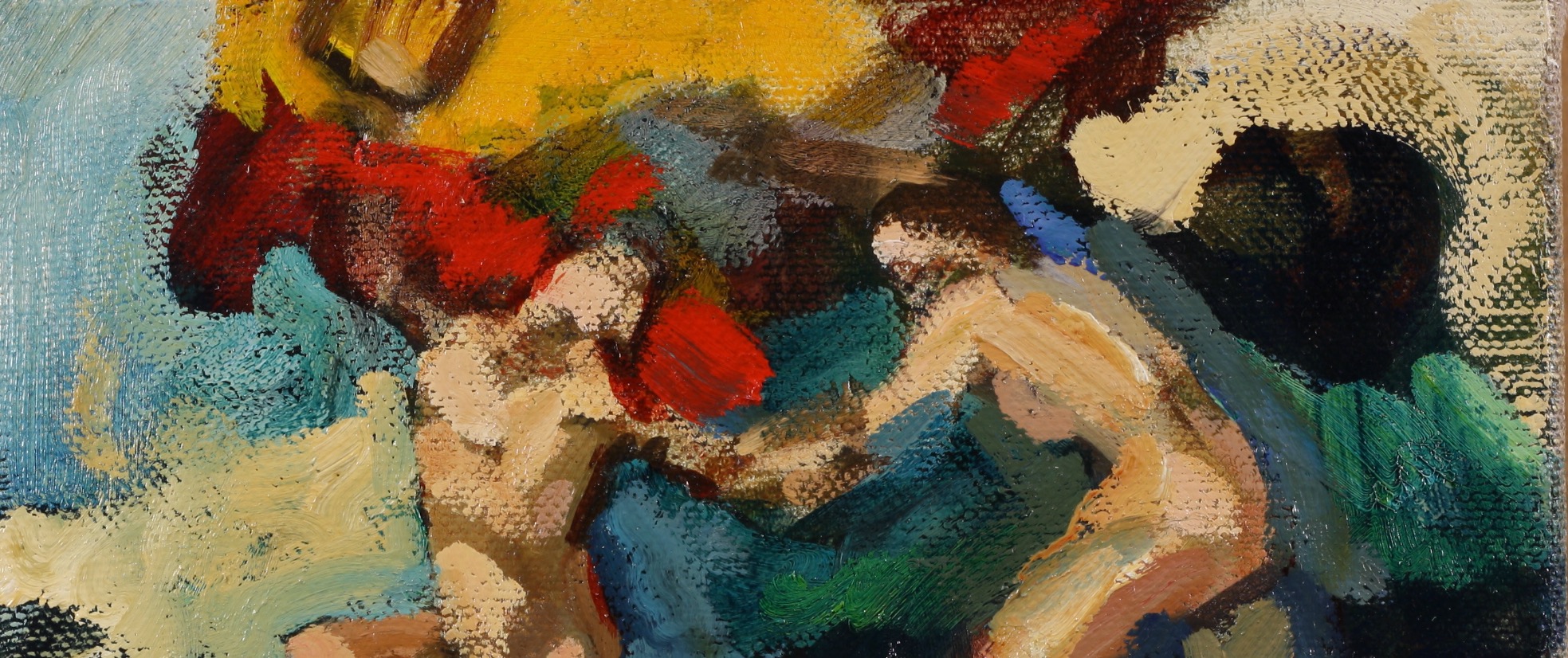
Beginning 2010 I painted a series 15 large canvases of approximately 200 x 200 cm along with related smaller oil studies, watercolors, drawings and etchings. These large canvases are related by both scale and treatment as well as content and theme. The content is that of monumental figures, usually over life-size and nude, set in dense, highly colored backgrounds containing many still-life elements. The treatment is observational and painterly. The themes are indirectly derived from mythology and literature and usually layered with symbolism and allegory.
My intention was to make contemporary paintings in what used to be referred to as the Grand Manner or historical paintings. Paintings inspired by Titian, Veronese and Rubens. This naturally accounts for the scale of my canvases as well as the color and compositions. Painters closer in time and more contemporary in technique which I value are Delacroix, Manet, and Corinth. These last had an impact on the surface treatment of my paintings. I wanted paintings with the weight of history and tradition behind them.
Each of these paintings has as its theme a mythological or literary origin. I try, however, to use obscure or lest well-known sources when possible and to suppress the references so as not to let the paintings seem to have a narrative. I wish the paintings to communicate aesthetically on a more abstract or intuitive level.
This series of paintings begins with bacchanalia subjects. Inspired by paintings by Titian, Bellini and Rubens among others, it contains all the elements I wished to develop. I wanted to create similar canvases with rich and sensuous content and power. Deep, full color with dense compositions and still-life elements are used to support the dominate nude figures. To this I use a loaded brush with visible and energetic brushstrokes. This approach I tried to maintain throughout the other paintings, while at the same time changing and developing the subjects and themes. The last paintings in this series return to this original theme with the subject of maenads.
For the next four paintings in the series, I looked to Celtic mythology and the Grail traditions. The image and symbol of a sacred Celtic severed head appear in these paintings along with the equally potent images of the head of Orpheus. These heads traditionally represent forces of healing and poetry.
I next returned to Classical mythology in two painting based on Elektra. The sources in this case are the myths, drama and opera. These are followed by the traditional Renaissance subject of The Annunciation but with a classical Orphic interpretation. The symbol of the disembodied head continues in these paintings.
The final three paintings were intended to represent in general images of Maenads in a bacchic trance or bacchanalia as the paintings in the beginning of this series. However, I wanted to introduce a more classic Renaissance structure to the compositions. This caused one painting to develop during the process of painting into the subject of Artemis with attendants. In another the Maenads due to their setting and poses appeared more like Sibyls than Bacchantes.
Much of the ideas and subjects in these paintings develop and change during the process of painting and never follow a definite plan. This is the proper development and life of a painting. There are many deviations and variants in the themes and subject, but they still maintain a unity of spirit, content and expression.